

Missing a receipt does not automatically prove or disprove an expense. The question is whether reliable records and legally acceptable evidence can establish the transaction, business purpose, date, amount, and any special substantiation elements.
Why this question matters
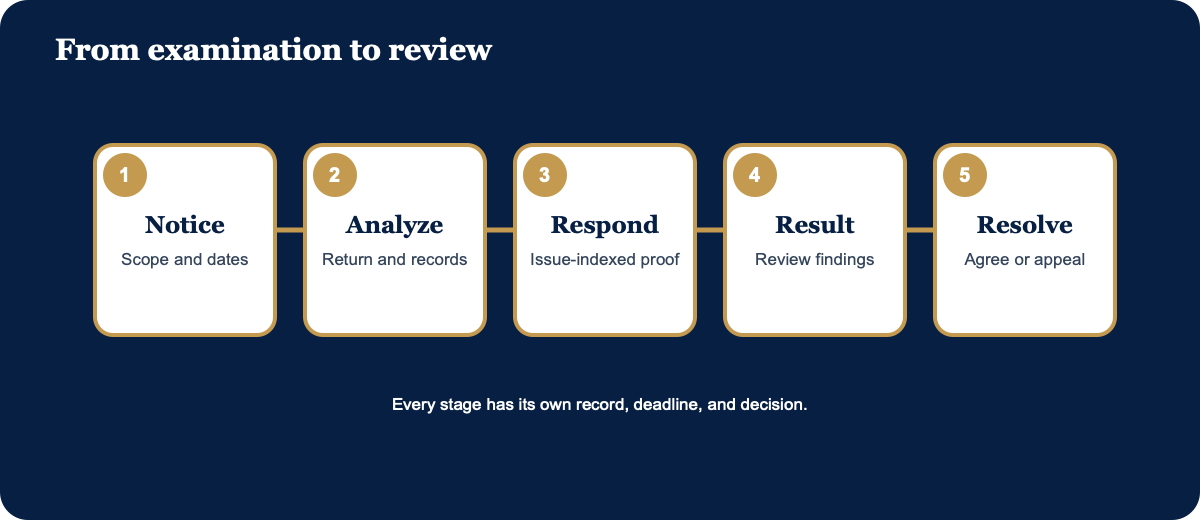
An examination tests selected items on a return. Organization, substantiation, controlled communication, and attention to later appeal rights are as important as the legal theory.
The correct response is specific to the taxpayer, tax period, notice, procedural history, and current agency rules. Do not use a general web article as a substitute for reading the actual notice or obtaining advice about a deadline.
A practical framework
1. Identify the exact element that must be proven for each item
Start with the record rather than assumptions. Identify the exact element that must be proven for each item.
2. Collect bank, card, vendor, calendar, mileage, contract, and third-party records
Connect each fact to a document and tax period. Collect bank, card, vendor, calendar, mileage, contract, and third-party records.
3. Separate direct evidence from estimates or reconstructed schedules
Consistency matters across forms, transcripts, and agency communications. Separate direct evidence from estimates or reconstructed schedules.
4. Explain the reconstruction method and preserve its inputs
Before submission, check the current form, address, delivery method, and deadline. Explain the reconstruction method and preserve its inputs.
Documents to gather
- The return under examination
- The information document request
- Books, receipts, statements, and third-party support
- A reconciliation by issue
Organize copies in chronological order and keep the originals secure. A short index showing the date, source, tax period, and purpose of each item can make agency review more efficient.
Common mistakes
- Creating unsupported numbers after the audit begins. This can weaken the factual record, consume a procedural deadline, or lead the agency to evaluate an option that does not fit the case.
- Assuming a bank charge alone proves business purpose. This can weaken the factual record, consume a procedural deadline, or lead the agency to evaluate an option that does not fit the case.
- Ignoring stricter substantiation rules for particular categories. This can weaken the factual record, consume a procedural deadline, or lead the agency to evaluate an option that does not fit the case.
When legal representation may help
Representation becomes more important when enforcement is active, several years or agencies are involved, the liability is disputed, records are incomplete, a business or third party may be exposed, or statements could have civil or criminal consequences. A sound engagement defines the problem, the work to be performed, who will perform it, the fee terms, and realistic objectives without guaranteeing a result.
Frequently asked questions
Can estimates ever be used?
Some situations permit reasonable reconstruction, while others have strict documentary requirements. The specific deduction and law control.
Will a spreadsheet be enough?
A spreadsheet can organize evidence but does not by itself prove the underlying transactions.
Visual guide
Primary sources
Sources were accessed for editorial research on 2026-08-12. Agency pages, forms, thresholds, and procedures can change; verify the current version before publication and before acting.
Important notice
This article provides general information, not legal or tax advice. It does not create an attorney-client relationship. Outcomes depend on individual facts and current law.