

A federal tax lien is the government’s legal claim against property after required conditions are met. A levy is a legal seizure of property or rights to property. Because the remedies and deadlines differ, the exact notice must be identified before responding.
Why this question matters
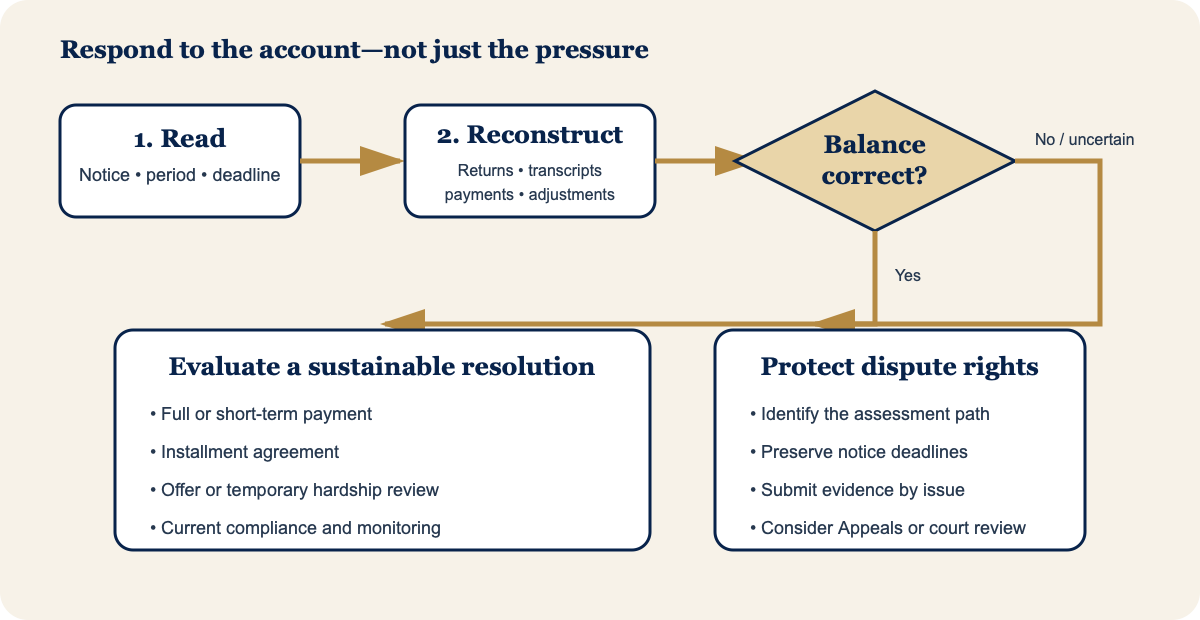
Collection cases are rarely solved by choosing a program name first. The account must be reconstructed, the liability checked, deadlines protected, and current compliance stabilized before a durable payment or hardship strategy can be evaluated.
The correct response is specific to the taxpayer, tax period, notice, procedural history, and current agency rules. Do not use a general web article as a substitute for reading the actual notice or obtaining advice about a deadline.
A practical framework
1. Read the notice title and code rather than relying on the envelope or a phone summary
Start with the record rather than assumptions. Read the notice title and code rather than relying on the envelope or a phone summary.
2. Identify whether the issue is filing, assessment, lien, proposed levy, or completed levy
Connect each fact to a document and tax period. Identify whether the issue is filing, assessment, lien, proposed levy, or completed levy.
3. Calendar every response and hearing deadline
Consistency matters across forms, transcripts, and agency communications. Calendar every response and hearing deadline.
4. Evaluate payment, appeal, release, withdrawal, discharge, or subordination procedures that may apply
Before submission, check the current form, address, delivery method, and deadline. Evaluate payment, appeal, release, withdrawal, discharge, or subordination procedures that may apply.
Documents to gather
- Every IRS notice and envelope
- Filed returns and account transcripts
- Income, expense, asset, and debt records
- Proof of payments and prior agreements
Organize copies in chronological order and keep the originals secure. A short index showing the date, source, tax period, and purpose of each item can make agency review more efficient.
Common mistakes
- Using the terms lien and levy interchangeably. This can weaken the factual record, consume a procedural deadline, or lead the agency to evaluate an option that does not fit the case.
- Waiting for a bank or employer to act before seeking advice. This can weaken the factual record, consume a procedural deadline, or lead the agency to evaluate an option that does not fit the case.
- Assuming a payment proposal automatically resolves a recorded lien. This can weaken the factual record, consume a procedural deadline, or lead the agency to evaluate an option that does not fit the case.
When legal representation may help
Representation becomes more important when enforcement is active, several years or agencies are involved, the liability is disputed, records are incomplete, a business or third party may be exposed, or statements could have civil or criminal consequences. A sound engagement defines the problem, the work to be performed, who will perform it, the fee terms, and realistic objectives without guaranteeing a result.
Frequently asked questions
Does a lien take money from a bank account?
A lien is a claim; a levy is the collection action that seizes property. The same account may involve both at different stages.
Can a levy be released?
Release may be available in defined circumstances, but timing and documentation matter.
Visual guide
Primary sources
- IRS Topic No. 201 — The Collection Process
- IRS Publication 594 — The IRS Collection Process
- IRS Topic No. 202 — Tax Payment Options
- IRS — Taxpayers Can Appeal an IRS Decision
- IRS — Collection Due Process FAQs
- Taxpayer Advocate Service — Collection Due Process
Sources were accessed for editorial research on 2026-08-13. Agency pages, forms, thresholds, and procedures can change; verify the current version before publication and before acting.
Important notice
This article provides general information, not legal or tax advice. It does not create an attorney-client relationship. Outcomes depend on individual facts and current law.