

April 10, 2013
Section 61 of the Internal Revenue Code tells us that gross income includes income from many sources including income from the discharge of indebtedness. The preparation of an income tax return becomes materially more complicated when the taxpayer receives Form 1099 from a creditor reporting an amount of a debt that has been written off. We are currently seeing a lot of those that arise out of foreclosures and short sales of real estate and from the write off of credit card debt. If you receive a Form 1099 from the discharge of indebtedness, you will need to properly report it on your tax returns.
This is not a simple matter. The first part of the analysis is whether any of the various exceptions to inclusion in income provided by §108 of the Code allow you to not include the forgiven debt in income. Exclusions provided by §108(a)(1) are:
(A) Discharge in the context of a Title 11 (bankruptcy) case
(B) Discharge to the extent of insolvency
(C) Discharge that comes from qualified farm indebtedness
(D) Discharge that comes from real property business indebtedness
(E) Discharge of qualified principal residence indebtedness
These exceptions are very complicated and require detailed factual and legal analysis. If you are able to exclude indebtedness under the (A) through (C), §108 then requires a reduction of tax attributes. You must determine the extent to which you have tax attributes and the order in which they are to be reduced.
A further complicating factor in this analysis is whether you are personally liable for the debt or whether it is non-recourse. That distinction makes a significant difference in how the transaction is reported. This requires an analysis of the instruments creating the debt and of state law. If there is no personal liability, there is no debt to be forgiven or discharged and there is no income to report.
When the debt forgiveness comes from a foreclosure or short sale, two parts of the transaction that must be addressed in the return. The first is whether there is gain or loss on the disposition of the asset. This requires a computation of adjusted basis, and if we are dealing with your house a determination of whether it qualifies as your principal residence. The second is the consequence of the discharge of the debt. Along with these substantive legal considerations there is the further complication of the forms, instructions, and software used to prepare the return.
Reporting FOI on a tax return is no simple matter and this is not a task It is advisable to undertake without competent, professional help. It is important to get the transaction property reported and documented on your tax returns for federal and state purposes. If you fail to do that, the likelihood of your return being audited goes up considerably and you may have to address the issues again years later in an audit.
Does the issuance of a Form 1099-C by a creditor absolve the taxpayer from liability for the debt? Instructions to Form 1099-C say that a creditor should issue this form to the debtor for any year in which a debt is canceled. However, in many cases, the creditor sends a 1099-C and continues to try to collect the debt. There is a split in the case law.
The fourth circuit has held that the creditor’s filing of a 1099-C simply represents the required means that the creditor must use to satisfy its reporting obligations to the IRS and does not result in a discharge of the underlying debt. FDIC v. Cashion, 720 F.3d 169 (4th Cir. 2013). This case cites information letters from IRS to that effect. Other courts hold that the creditors issuance of a 1099-C is prima facie evidence that the creditor discharged the debt. The National Legal Research Lawletter, vol. 43, No. 7 has more analysis. Most of these cases should be resolved by expiration of the state law statute of limitations on collection.
Practical next steps
- Note the date on this article. It describes the rules as they stood then, and tax procedure changes.
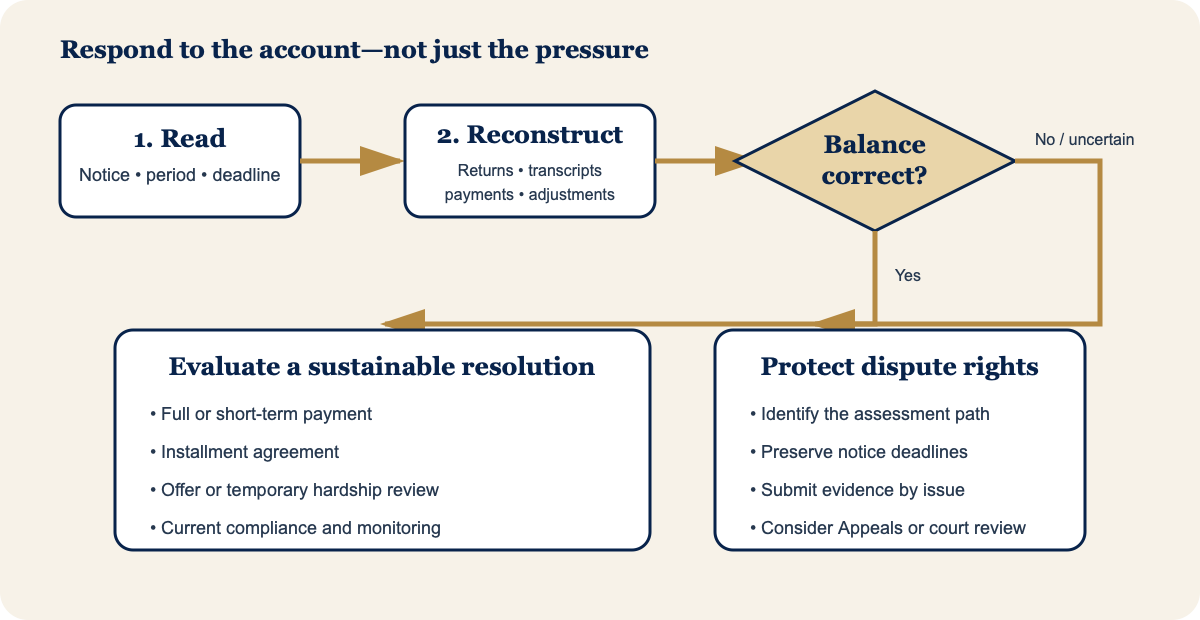
- Start from the notice you actually received: the number in the top right corner and the date printed on it decide what is still open to you.
- Pull your account transcripts before deciding anything. They show what the IRS believes about your account, which is not always what the letters say.
- If a deadline is running or the amount is significant, have someone read the file before you respond.
Visual guide
Official sources for current verification
- IRS Topic No. 201 — The Collection Process
- IRS Publication 594 — The IRS Collection Process
- IRS Topic No. 202 — Tax Payment Options
Important notice
This material provides general information, not legal or tax advice. Tax outcomes depend on the facts, procedural history, applicable law, and current agency guidance. Reading this page does not create an attorney-client relationship.